
One Good Story, That One by Thomas King

In the rollicking collection 'One Good Story, That One', indigenous author Thomas King writes colloquially, in traditional oral storytelling style, peppered with his unique brand of wit and insight. King is one of Canada's finest storytellers, and author of the acclaimed 'Medicine River', 'Green Grass, Running Water', and 'Truth and Bright Water'. These sometimes magical, often whimsical tales, bring past and present into conversation and collision with plenty of help from mythic figures like the trickster Coyote.
What would happen if a character from one of your favourite myths showed up on your doorstep? What would you talk about? How might they change your life, or how might you change theirs?
Mae Among the Stars by Roda Ahmed

Mae Among the Stars is a picture book inspired by Mae Jemison, the first Black woman to travel in space. It is illustrated by Stasia Burrington, a Japanese-American illustrator, and written by Roda Ahmed, a Norwegian author born in Somalia, who can speak five languages!
Mae’s mother doesn’t judge or laugh at Mae for dreaming big—she encourages her! Who encourages you in your life? How do they support you? Who do you encourage? Are there any ways you can show them even more support?
The Powwow at the End of the World by Sherman Alexie

Sherman Alexie is also the author of "The Absolutely True Story of a Part-Time Indian," a novel based on his life growing up on the Spokane Indian Reservation in Washington State. The poem challenges what challenges and limitations the quest for Truth, Reconciliation, and Forgiveness really entails.
How would you work towards Truth and Reconciliation in Canada?
Phyllis (Jack) Webstad's story in her own words...
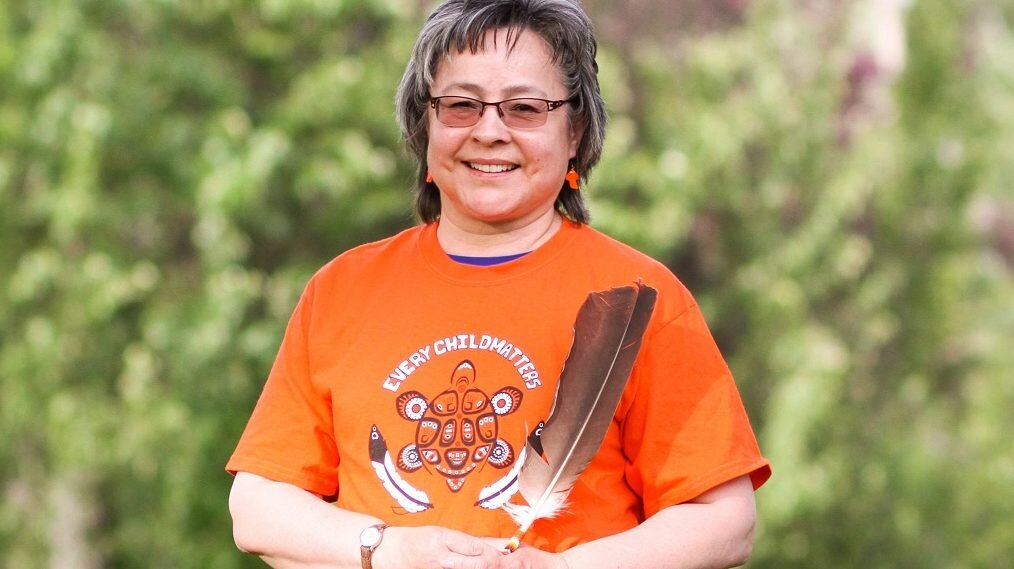
As we approach the first National Day for Truth and Reconcilation, take a momemt to reflect on both the history of Orange Shirt Day and the reasons why this day of remembrance is so important. Understanding Canada's past and the impacts of goverenemnt policies that still revereberate today are an important step to reconciliation.
From Injun by Jordan Abel

Nisga'a poet Jordan Abel is the winner of the Dorothy Livesay Poetry Prize and the Griffin Prize, and the author of several books of poetry, including Injun - a powerful critique of how indigenous people in North America have historically been represented. Abel pieced these poems together from the text of nearly 100 novels written in the western genre between 1840 and 1950, effectively reclaiming and unsettling language mired in a destructive colonial legacy, and framing new possibilities for indigeneity.
When We Are Kind by Monique Gray Smith

When We Are Kind, by Monique Gray Smith, examines the way that nature and kindness are related in our quest for building community.
Monique Grey Smith is a proud mom of twins and award-winning author of Cree, Lakota and Scottish heritage. She is well known for her storytelling and kind spirit.
Write about something you can do this week to show kindness to others.
Grace BY Joy Harjo
Grace by Joy Harjo is one of the poems from a book In Mad Love and War. In it she draws parallels between the change in seasons and the experience of segregation. Like grace, Spring enters and attempts to bandage the wounds inflicted by the winter.
How is reconciliation like a cycle?
Walking Both Sides of an Invisible Border by Alootook Ipellie

Alootook Ipellie was an Inuit poet born in Nuvuqquq on Baffin Island, in what is now known as Nunavut. Throughout his youth, Ipellie moved all around the country to live with family members and in foster homes. Despite his incredible talent, he was discouraged from pursuing artistic studies in high school. He went on to become an internationally known journalist, Inuktitut translator, graphic artist, and cartoonist. Issues of colonialism, spirituality, and the navigation of cultural identity are threaded throughout his work. Ipellie died of a heart attack in 2007.
In the face of competing expectations from parents, friends, teachers, and society as a whole, how do you hold true to your identity?
When I Was Eight by Christy Jordan-Fenton and Margaret Pokiak-Fenton

Based on her experiences at a residential school in the Canadian arctic, When I was Eight tells the story Margaret Pokiak-Fenton was named Olemaun at birth. Unlike most Inuit children, she begged to go to school, despite the horrific reputation of residential schools, because she was determined to learn how to read, no matter what. Margaret Pokiak-Fenton now lives in Fort St. John, British Columbia. Her daughter-in-law Christy Jordan-Fenton helped write her mother-in-law’s story.
During her time at the school, Olemaun draws courage from the character in the book, Alice’s Adventures In Wonderland. Write about a book, movie, song, or other piece of art that is important to you and why you love it.
You Hold Me Up by Monique Gray Smith

You Hold Me Up is a picture book by First Nations author Monique Gray Smith. The simple, beautiful words remind us of the importance of helping one another find happiness.
Monique Gray Smith is a proud mom of twins and award-winning author of Cree, Lakota and Scottish heritage. She is well known for her storytelling and kind spirit.
Write about a time when you “held someone up” and helped them find happiness. Or, write about when someone else “held you up.”
The Edward Curtis Project by Marie Clements

In the early 20th century, the photographer Edward Curtis published "The North American Indian"—a photographic catalogue of indigenous people from across the continent. It was much celebrated in the past for capturing what was deemed a "vanishing race". Métis playwright, performer and director Marie Clements contests and critiques Curtis' legacy in her compelling and challenging piece of multimedia theatre, exposing the fraught colonial attitudes and destructive perspectives propagated by his work, including the attempted silencing and erasure of a people that never vanished at all.
Photography is a powerful medium that can move us deeply. Choose a famous historical photograph and write a description of it. What makes the photo so powerful? What feelings does it invoke in you?
The Second Time by Rosanna Deerchild

This poem deals head-on with Residential Schools. Rosanna Deerchild is a Canadian Cree writer, poet and radio host. She is best known as host of the radio program Unreserved on CBC Radio One, a show that shares the music, cultures, and stories from indigenous people across Canada, from 2014 to 2020. She is the co-founder and remains a member of the Aboriginal Writers Collective established in 1999. The collective, a group of Manitoba writers, has released two collections in print, urban kool and Bone Memory, and a live spoken word CD, Red City. Rosanna has also performed live comedy and has written book reviews for the Winnipeg Free Press. Her first book, This is a Small Northern Town, is a full-length collection of poems that looks at a small northern town that is heavily divided along colour lines and holds long family secrets.
Deerchild's second book, Calling Down the Sky, is a deeply personal piece about Canada's Indigenous Residential Schools. This book is, in part, the product of a multi-year healing journey and tells the story of Deerchild's own mother and her struggles as a generational survivor of residential schools. This book also won the Lowther Memorial award in 2016. Deerchild and her mother Edna Ferguson wrote a poetry book about her residential school experience together.
Deerchild originates from South Indian Lake, Manitoba (Now called O-Pipon-Na-Piwin Cree Nation). She now lives in Winnipeg, Manitoba. In 2018 she was able to accomplish one of her dreams, which was to be an emcee in a powwow.
Write with empathy in reponse to the continuing discovery of the atrocites that was a result of the Residential Schools program.
Shi-shi-etko by Nicola I. Campbell

Nicola I. Campbell is a Nłeʔkepmx, Syilx, and Métis author who writes about healing, nature, respect, and understanding. Her book, Shi-shi-etko is about a young girl who is leaving for a residential school in four days. We journey through the girl's questions, fears, and hopes, and watch her package memories of her family and home to bring with her to the school.
What special memories do you have of your family or your home? Write a memoir entry about them, and remember to include the five senses to make it more interesting!
When We Were Alone by David A. Robertson

David A. Robertson is a Swampy Cree author who won the 2017 Governor General's Literary Award for his book When We Were Alone, illustrated by Julie Flett. The book tenderly tells the story of a young girl asking her kókom (Grandmother) about many of the traditions she holds. She learns of her kókom's time spent in a Residential school as a child, and the way that she now shares her culture and traditions with great pride.
Write a response about the kind of traditions you share with your grandparent(s) or parent(s). What makes those values and traditions special to you?
The Science of Breakable Things by Tae Keller

Tae Keller is a Korean-American author who spent her time growing up in Hawaii. In The Science of Breakable Things, Keller tells the story of Natalie, who recently rediscovers her love of botany. In chapters called assignments, Natalie teaches us about love, science and mental illness. She brings us through the egg drop competition, her science classes with Mr. Nelly, and living with her depressed mother. We learn that some things are breakable like eggs, and also the things that aren’t, like family and friendship. Keller uses the format of experiments and some hopeful tinkering to illustrate the human condition with love and loss. How have you experimented with things in your life?
I listen by Janet Wong
I Listen by Janet Wong
Once in a while
I wake up in the dark
and I look around my room.
I listen to the sounds in my house-
the refrigerator humming,
the heater clanking,
Mommy's soft breathing,
Daddy’s noisy snores.
My own breath
make the sound of the water in a puddle
on a warm but windy day-
woosh and shush and
woosh and shush and-
then
I fall back asleep.
Janet Wong graduated from Yale Law School but found her true calling to be in writing, publishing and sharing poetry with children. In 2021, she became the first Asian American writer to be awarded the NCTE Excellence in Poetry for Children Award, the most prestigious lifetime achievement award that a children’s poet can receive.
Ms. Wong writes poems to be spoken and poems to be shared, poems about feelings and poems about happenings, poems that might challenge you and poems that might bring you comfort.
What do you hear at night? Or at any point in the day?
Monkey Beach by Eden Robinson

Monkey Beach tells the story of Lisamarie in the British Colombian village called Kitimat. The author, Eden Robinson, expertly weaves Haisla cultural beliefs and practices into a mystery story of Lisa’s missing brother, Jimmy. As a reader we are exposed to a plethora of topics: Haisla family structure and nomenclature, the effects of intergenerational trauma on indigenous groups, worldviews and indigenous values on the use of land and life. In doing so, Robinson also reclaims appropriated Haisla myths and lore. She uses the traditional terms for what we know now to be ‘Sasquatch’ as the Haisla ‘B’gwus,’ explores Haisla spirituality, and the use of non-traditional medicines to provide the reader with different connotations of each practice, and build cultural competency. Branching off from this, Robinson uses Lisa’s journey of finding and embracing her spirituality to encourage her audiences to examine their identity, culture, and obligations to their past, present and future selves. Tell us about a cultural belief or practice you engage in!
How has this been a part of your life?
“Equal Opportunity” by Jim Wong-Chu

Jim Wong-Chu (1949-2017) was an artist, then a teacher. Under the neon lights of Vancouver’s Chinatown, he captured its life—its inhabitants, its architecture, its everyday—in unreserved detail through photography, poetry, and prose. He devoted his art, his photography and poetry, his editing and event-organizing to highlighting the stories of Asian Canadians. Having arrived in Canada just after the Chinese Exclusion Act, Jim Wong-Chu had to learn how to navigate a society whose fabric was still very much interwoven with anti-Asian sentiment. Nevertheless, he found his calling, taking the lead in carving out more space for Asian Canadians to find their own artistic interests and explore their suppressed heritage. J. Wong-Chu had himself come to Canada as a “paper son,” someone who had immigrated with a false identity. ‘Paper children’ often kept their real past a secret from their descendants, severing them from their family history. Wong-Chu, however, worked to connect those severed lines that ran between person and past. His book, Chinatown Ghosts (1986), is a testament to this effort. The first Chinese Canadian poetry book to ever be published, it captured intimately the daily dislocations faced by Asian Canadians. He was celebrated for cultivating a love of the arts among his community through performances and readings, conferences and gatherings. He incessantly encouraged Asian Canadian writers to write, giving them advice and introducing them to publishers.
This week’s poem is “Equal Opportunity”; a poem that highlights the turmoils, hardships, and discrimination of Chinese workers during the construction of the Canadian Pacific Railway. Upon reading his poem, think about a time where history has taught you a valuable lesson. If you feel inclined to do so, please submit a response below.
My Chinese by Athena Chu

My Chinese by Athena Chu
If you ask me if I’m fluent in Chinese, I will tell you my Chinese is a ghost lodged in my throat. A dried up flower I tore from the ground long ago, rootless.
My Chinese is missing pictures in a photo album: the first day of preschool, a mouth full of useless characters, ancient taste buds numbing out of existence, leaving the bitter aftertaste of a new language.
My Chinese is kneaded dough cut into little circles, filled with meat and folded over, cooked and served with vinegar in porcelain dishes.
My Chinese wears red dragons on silk qipaos, dressed in pearls and jade earrings. My Chinese is red. My Chinese is gold.
My Chinese is something I must hide.
My Chinese is a racist joke I threw in the garbage, wrapped in a napkin, stained with my culture and made a sound as it hit the bottom.
A sound as in the weakness in armor. A sound as in crevice, gap, hole. A sound as in the slits they called our eyes.
My Chinese remembers Yellow Peril hysteria, Chinese Exclusion Act, remembers alienation, remembers otherization, remembers being banned from this land, being treated as everything but human, remembers the clanking of metals to railroads as immigrants built train tracks to connect this country. My Chinese remembers. My Chinese forgets.
If you ask me if I’m fluent in Chinese, I will tell you that my Chinese doesn’t think it belongs here sometimes.
Sometimes my Chinese is angry.
My Chinese wonders why, “Hey, this person I know is really into Asian girls. You should talk to them,” is a compliment. My Chinese wonders why it is exotic, why you think fetishizing my culture is the same as loving it.
My Chinese wonders why it is beautiful only if it is white enough. My Chinese wonders if it is white enough.
My Chinese wonders why it is minority only when it is convenient, wonders why the massacres, mass expulsions, and near genocidal policies are missing in the history textbooks. My Chinese wants you to know that it is not invisible.
My Chinese wants you to know that it is not an accessory for you to wear. My Chinese wants you to remember that it cannot be eaten and then spit out.
But even I forget sometimes.
My Chinese settles for less than what it deserves sometimes.
If you ask me if I’m fluent in Chinese, I will tell you that my Chinese sits in the back of class, knows the answers, but does not raise hand.
My Chinese sits quietly during family reunions, knows what they are saying, has something to say, but can’t. My Chinese is reaching for words, but only finding air.
If you ask me if I’m fluent in Chinese, I will take you to the grave where my Chinese lives.
On the tombstone it says: Here lie decomposing words. Here lie broken skeletons and broken sentences. Here lie rotting corpses and rotting cultures. Here lie the missing limbs of history. Here, in memory.
Here. Take a shovel and dig with me.
Debuting in a 2016 Slam Poetry competition in Boston, Massachusetts, Athena Chu's poem, drawing inspiration from Melissa Lozado-Olivia's "My Spanish", captures the pain felt by those who are disconnected to their mother tongue and culture, but who remember enough of that connection to feel the aching of what they are missing. In 2018, during her senior year in high school, Athena Chu was a Writing/Spoken Word Finalist and a Cinematic Arts Finalist at the National Young Arts Foundation's annual competition. She was. the only Finalist out of 757 students, who were selected from a pool of 7,500 students, to be nominated in two separate categories. During that competition, she also received a nomination for the US Presidential Scholars Program. Athena Chu is currently an undergraduate student at Princeton studying Comparative Literature.